Clearly, the game is key. Without the game, customers have no reason to join the online gaming community. Plus the game server is the most demanding component of your infrastructure: The transaction load is characterized by a large amount of updates and reads. These transactions have to be processed in an environment as near latency-free as possible. Every move a player makes, as well as every item, object, and monster is at least one data element within the game's database – in an MMOG, literally hundreds of thousands of players are performing these updates constantly.
So when it comes to data management for MMOG, publishers and their developers need a future-proof solution that supports minimum latency via clustered caching, high performance via parallel processing, high availability and data partitioning for scalability. Plus, they need a technology that reduces the risk of unavailability while helping to maximize profits.
Play it smart! Cause, when it comes to game evolution, they need even more. Maximize your profits and secure the future with these smart decisions.
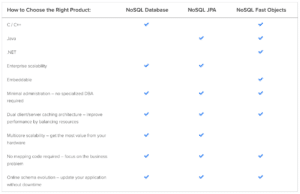
Play to win! Consider the following facts before your MMOG application is built. You need:
Traditional relational database technologies can struggle to keep pace with these new demands. If you play to win, use the Versant Object Database to unconditionally accelerate development, performance and – equally important – the evolution of MMOG applications.
Using the Versant Object Database, publishers and their developers get a future-proof data management solution that accelerates time-to-market today and leaves the door open for tomorrow’s requirements and enhancements.
The Versant Object Database provides in memory database performance for minimum latency transactional thoughput allowing immediate return to game logic control without waiting on backend I/O operations. Versant uses piggy backed double buffering to ensure non-blocking memory writes. The minimized waits on backend structures facilitate thousands of concurrent updates per second on a given data node that is supporting a cluster of shards. A single data node is capable of supporting tens of thousands of active game clients.
The shard cache is designed to work with distributed data nodes without requiring coding that is aware of the physical distribution. Operations, such as queries, on the data nodes are defined with logical units and carried out with threads executing in parallel within the shard and data nodes. Game objects may even have relationships spanning physical data nodes without any special code to handle the proper redistribution of game state. Changes are automatically moved to the correct data node on flush operations or transaction boundaries.
The game shards have the ability to define replica sites for their data nodes. Replicas are written sychronously using parallel processing to provide redundancy of data operations with minimal overhead. Failure in any data node is automatically detected and shard activity is continued to the live site with zero transaction loss. Even in flight transactions are recovered and failed sites are resynchronized to bring full synchronous replication back online.
Each data node can define physical clustering rules for logically related game objects. This means for any given data node that does not completely fit into memory, disk I/O operations will be minimized by loading logically related objects in a single disk seek. This significantly reduces wait time within the data nodes faciliating faster read-ahead loading algorithms and the support of larger user bases with a single data node process.
Game objects can be added and evolved online without taking the data nodes off-line or restarting shards. Game schema information is versioned and existing objects are lazily evolved on access allowing evolution of multi-terabyte databases in seconds. Existing game objects are loosely coupled with the data tier schema allowing older game objects to continue to interact with improved data nodes.
Game object lifecycle management is seemlessly integrated with a horizontally scalable cluster of shard caches. Each shard is capable of holding all or a portion of the complete game world. Individual shards are multi-threaded and capable of supporting tens of thousands of users. Clustering the shard caches provide horizontal scalability to the multi-million user base of a successful game.
The Versant Object Database is designed for outstanding performance in high workload environments. Hence it requires less hosting footprint as traditional relational database systems which simply cannot provide the same performance. When it comes to Return-on-Investment (ROI) and Total-Cost-of-Ownership (TCO), this dramatically reduced footprint leads to extreme savings of shelf space and energy. So it’s not only about „green“ technology but also about ,,saving'' money.
Part of the business is to understand that the cost of hosting a MMOG will likely outweigh the initial capital cost of the equipment. You need to make the right technical decisions to keep these hosting costs down: Selecting the Versant Object Database to minimize shelf space, cooling, and electrical power requirements will pay off in the long term and will likely reduce the initial hosting costs.
As the success of MMOG platforms depends upon technology, a reliable foundation is essential. Hence reliability is a key factor to consider when choosing a data management system. That’s why the Versant Object Database has not only been selected for MMOG platforms like Gundam Online and Tournament.com and various defense simulations – it also serves as the data management backbone for applications of Ericsson, Verizon and the Financial Times.
Whitepaper "Advanced Data Management in MMOG"
Versant Object Database Product Overview
Versant Object Database in MMOG:
Future-Proof Data Management
"Applying Metrics Driven Development
To MMO Costs And Risks"
A Whitepaper by Larry Mellon
Technical Questions:
Message Boards
Purchase Inquiries:
Versant Object Database
FastObjects .NET
General Questions:
Quick Message Form
For postal adresses, phone numbers, e-mail addresses, driving directions etc please refer to:
Get a free 60-day Evaluation copy and testdrive the Versant Object Database or FastObjects .NET! Downloads are available within the Versant Developer Center:
Versant is offering a free one-day “checkup” of your Versant database setup and server configuration.
In today's fast paced world you want to be part of a company that is on the leading edge of technology? Join Versant!
The Versant Developer Center (VDC) provides all the essential information and valuable resources needed for developers, just like
OEM Partner Program: Versant offers independent software vendors and
value-added resellers an OEM Jump Start Package for free!
www.versant.com | Copyright © 2003-2008 Versant Corp. All rights reserved.
For questions about this site please contact webmaster@versant.com
Versant, Vitness, Vorkout, Vildcard, Vhistle, Vhisper, Varehouse, Vedding, reVind and FastObjects are either registered trademarks or trademarks of Versant Corporation in the United States and/or other countries. All other products might be a registered trademark or trademark of their respective company in the United States and/or other countries.
Add-on Modules for the Versant Object Database.
If mission critical deployments are a part of your business or if you need to access data through SQL, Versant provides Enterprise-class Add-on Modules for the Versant Object Database.
The observation of a production system is a cornerstone to the proper establishment of an adequate System & Network Management policy.
Using Versant Vitness for the advanced monitoring of your entire Versant Object Database environment provides you with a fundamental tool for all database administration operations and decisions.
The Vitness add-on module delivers real-time views of performance data and analytical information about the Versant Object Database at the push of a button. Proactive database monitoring prevents potential faults that could be unexpectedly generated by an unobserved system - Versant Vitness alerts administrators before database availability is affected. Can life get any easier?
Versant Vorkout is a Database Reorganizer Tool for applications that delete large numbers of objects. It lets you reclaim unused space in your database while it is in normal operation, increasing available free space and improving database performance. Last but not least Vorkout is tightly integrated and can be used through Versant Vitness.
Over time as objects grow or are deleted, empty holes are created in the tightly packed database resulting in fragmentation of data segments. Thus, performance starts degrading and disk usage is also increased.
Versant has addressed this issue by introducing Vorkout - the enhanced tool provides the user the ability to analyze a database for wasted space and reorganizes the data for reduced fragmentation and restored performance.
Vedding is an add-on software module for the Versant Object Database enabling automatic fail-over and recovery in the case of hardware or software failure. This is commonly known as a Fault Tolerance environment.
Vedding uses synchronous replication between two database instances and supports transparent re-synchronization in the event of a failure. Synchronous database replication mirrors the contents of one database to another in a predictable and orderly manner. This provides either local or geographically remote redundancy, which protects against the unavailability of data.
The Vhistle add-on module for Asynchronous Replication supports both master-slave and peer-to-peer asynchronous replication between multiple Versant Object Database servers. This can be used to replicate data to a distributed recovery site or to replicate data between multiple local object servers for increased performance and reliability.
In many applications, there is a need to replicate data, typically to improve availability, to improve performance by geographically co-locating databases with the applications that access the databases, to isolate decision support systems from online production systems, and to help in recovery from failures using warm-standby systems.
Vhisper provides Warm Standby capabilities to a Versant Object Database. The add-on module is used as an incremental rollforward recovery. It is designed to minimize the downtime in an emergency event.
With Vhisper, an up-to-date copy of the primary database is maintained - this is a Warm Standby database. In case of an emergency, the Vhisper's Warm Standby database can be updated very quickly to the state of the primary database. Instead of starting a full database restore that may take a considerable time with large databases, you just need to apply the last roll forward archive plus the logical.log of the primary database to the Warm Standby database - and you are ready for anything.
Varehouse is an add-on software module that enables the Versant Object Database to use the disk mirroring features of EMC Symmetrix or other enterprise storage systems to take an online backup of very large data volumes without impacting availability (High Availability Backup, HAbackup).
Varehouse, Versant's High Availability Backup solution, is a generic way of achieving continuous online backup of the Versant Object Database. It exploits the capabilities of special storage devices. It allows the user to execute certain operations such as, splitting a mirrored device, after bringing the database to a consistent state.
Vildcard enables you to run a discounted standby server in parallel to your initial Versant Object Database server.
Most likely, Vildcard is used for generic cold standby environments where backups are accomplished manually in certain periods.
reVind is an Add-on module for the Versant Object Database. The Versant/SQL suite of software modules permits you to use conventional Structured Query Language (SQL) semantics to access data that resides in a Versant Object Database.
The resulting application architecture can offer the strengths of both the relational and the object database models, such as the openness and interconnectivity of relational tables along with the expressiveness and performance of object collections.