NoSQL object databases
Object database management systems for enterprise-level and embedded systems.

What is NoSQL Database?
NoSQL object technology makes it easy for software developers to handle transactional database requirements for extremely complex object models. The world’s largest companies use NoSQL for applications with large-scale data management in enterprise environments. High availability, fault tolerance, synchronous and asynchronous replication are built-in. NoSQL Database doesn’t need mapping code to store or retrieve object data, so schema modifications are handled without design bottlenecks.
What is Actian NoSQL FastObjects?
Actian NoSQL FastObjects is a high performance, transactional object management system designed to meet the requirements of object oriented programmers with a need to manage application objects with a robust database engine. It works equally well in embedded or client/server applications.
Code less, conceive more, run faster

Agile development
Since the object model matches the database schema, programmers using Java, C/C++ and .NET SDKs are more productive.
Performance and scalability
Object navigation follows references embedded within the object definition, so there are no queries or relational mapping to slow performance.
Operational efficiency
Full set of enterprise features: 24×7 operations, fault tolerance, replication, online backup, snapshots, scale-out across multiple databases.

Agile development
Performance robustness and scalability.
Performance superiority
NoSQL outperforms RDBMS and NoSQL alternatives.

NoSQL object data model simplifies application development
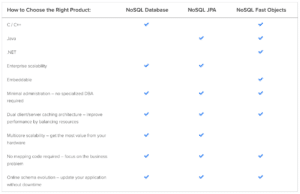
Three choices for implementation using C/C++, Java, and .NET software development kits
Use cases
Object database with high availability and replication.
Network route optimization
Large telecommunications companies use NoSQL JPA to run route optimization algorithms in the Data Services function of their Operating Support Systems. The key benefit is the ability to handle very complex networks for relationships, with orders of magnitude faster traversal and identification of patterns.

Metadata management
Medical and scientific companies use NoSQL to manage metadata and telemetry information from instruments, providing time-critical access to complex relational data that is best represented in an object model. NoSQL provides the persistence, data integrity, abstraction, and replication to ensure applications can manage, navigate and access complex data structures.

Fraud detection
Retailers, online services, and financial services companies use NoSQL to manage and search large volumes of data for patterns that identify unauthorized transactions or access to protect their business and customers. Using rules-based pattern recognition and advanced statistical methods, these applications rely on NoSQL to be highly configurable, customizable, and scalable to deal with rapid changes in strategy and rules to react to evolving threats.

Content management
Publishers use NoSQL as the data manager for their content management systems. NoSQL handles complex schemas of structured, semi-structured, and unstructured data objects that represent different content and metadata, delivering a flexible and responsive system that can evolve over time to handle new data types and schemas.

Simulation
The performance and object orientation of the NoSQL database is a perfect fit for real-time simulation and modeling systems. NoSQL supports high performance object data ingestion and retrieval, and provides developer tools that are easier to use compared to a traditional SQL database. Reservoir simulations for oil exploration as well as weather simulations for government and commercial applications use NSQL.